 by Helal
How to Clean Your Aircon Filter: A 10-Minute Guide
This is the single most impactful thing you can do for your aircon between professional services. It takes ten minutes, requires no tools beyond a vacuum and a tap, and prevents about half the issues we get called out for during summer.
Here’s how to do it properly.
Why filter cleaning matters
The filter sits behind the front panel of the indoor unit. Its job is to catch dust, hair, pollen and other particles before they reach the cooling coil. After a few weeks of running, it starts to clog. After a few months, it stops being a filter and becomes a felt mat.
What that costs you, in order of severity:
The system runs less efficiently because airflow is restricted, which adds 10 to 20% to your power bill on a heavily clogged filter. The cooling coil can freeze because not enough warm room air is reaching it, which can damage the system. Dust that should have been caught by the filter ends up on the coil itself, where it’s harder to clean and starts to support mould growth. The fan motor works harder against the restriction and wears faster. And the air in the room is dustier than it should be.
All of this is preventable in ten minutes.
How often to do it
For a typical Sydney home in summer use, every 4 to 6 weeks. More often if any of the following apply:
You’ve got pets, especially shedding breeds. Two cats or a dog mean every 2 to 3 weeks during heavy use.
The system runs constantly (8+ hours a day in summer).
You’re in a dustier area (Western Sydney generally, or anywhere near construction or major roads).
Anyone in the household has asthma, hay fever or allergies. Cleaner filters mean noticeably better symptoms.
It’s been spring or autumn in Sydney recently. Pollen seasons load filters faster than people expect.
In winter when you’re not using the aircon much, you can stretch the interval out. Once a season is fine if the unit is barely running.
What you need
A vacuum cleaner (any will do, a brush attachment helps but isn’t essential), access to a tap, and somewhere the filter can dry flat for an hour or two. That’s it. No special cleaners, no chemicals, no tools.
Don’t use harsh detergents, bleach, or hot water above 40°C. Mesh filters are made of plastic frame and synthetic mesh that doesn’t tolerate any of those things well.
Step by step
Switch the system off. Use the remote or the controller, then for good measure flick the isolator on the wall near the indoor unit. Two reasons: safety while you’re working near the unit, and it stops dust getting kicked up by the fan if anything switches on accidentally.
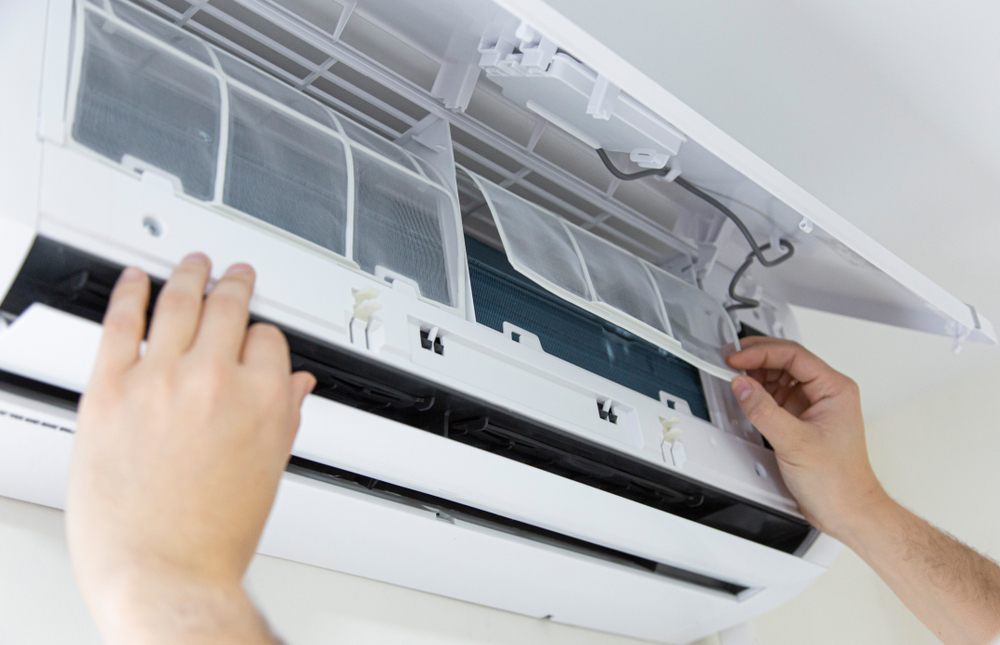
Open the front panel. On most split systems, there are two small tabs on either side of the front panel near the bottom. Push them in slightly and the panel hinges upward. On some units it lifts straight off. If you’re not sure, the unit’s manual will show you.
Slide the filter out. It’s a plastic frame with a fine mesh screen, usually one or two filters per unit. They slide out from the top once the panel is open. Note which way around they go so you can reinstall them correctly.
Vacuum the worst off. Hold the filter mesh-side up over a bin or outside, and run the vacuum across both sides. This gets you 80% of the dust with no mess.
Rinse under the tap. Lukewarm water, mesh-side up first, then flip and rinse the other side. Keep rinsing until the water runs clear. If the filter is genuinely matted, you can soak it in lukewarm water with a tiny amount of dish soap for ten minutes before rinsing, but for most filters this isn’t needed.
Let it dry completely. Lay it flat (not folded, not propped on a corner) somewhere it can air-dry. An hour in indirect sun is usually enough, longer in winter or humid weather. Don’t reinstall a damp filter, it’ll grow mould on the cooling coil.
Slide it back in. Same orientation as it came out. Close the front panel until the tabs click. Switch the isolator back on, then fire up the unit.
That’s it. Genuinely the whole job.
A few practical notes
Some indoor units have multiple filters. Standard Daikin, Mitsubishi Electric and Fujitsu splits have one or two mesh filters. Premium models sometimes include an additional electrostatic or PM2.5 filter that gets replaced (not washed) every 12 to 18 months. If your unit has these, the manual will specify. They’re optional extras, not the primary filter.
Ducted systems work the same way but the filter is in a different spot. It sits behind the return air grille, usually on a hallway ceiling or wall. Larger filter, same process: vacuum, rinse, dry, reinstall. Some homes have an additional filter behind the indoor fan coil unit in the roof, accessed through a service panel. That one’s worth letting the tech handle during the annual service.
Don’t skip the rinse step. Vacuuming alone gets the loose dust off but doesn’t clear the fine particles trapped in the mesh. The water running clear is your sign the filter is properly clean.
If the filter looks damaged, replace it. Tears in the mesh, broken plastic frame, or a frame that’s warped from being washed in hot water all mean it’s not doing its job. Replacement filters are available from the manufacturer or any aircon supplier, typically $30 to $60. Don’t run the system without a filter while you wait for a replacement, dust ends up on the cooling coil and is a much bigger job to remove.
What filter cleaning won’t fix
Worth being clear about the limits.
If the system is leaking water, smelling musty even with a clean filter, making unusual noises, freezing up, or not cooling properly despite the filter being clean, you’ve got a problem the filter clean won’t solve. That’s tech territory. Filter cleaning is the first thing to rule out, not the answer to everything.
A clean filter is the baseline. Past that, the system needs proper professional servicing once a year (chemical coil clean, drain flush, refrigerant pressure check, electrical safety inspection) which is what extends the system’s life and catches issues before they become expensive.
Frequently asked questions
Can I run the system while the filter is drying? No. The filter is there to protect the cooling coil. Running the system without it means dust loads onto the coil, which is harder to clean and reduces system efficiency. Wait the hour or two for the filter to dry properly.
My filter has a tear in it. Is that a problem? Yes. Air takes the path of least resistance, so a tear means most of the airflow bypasses the filter. Replace it.
Do washable filters last forever? Realistically, 5 to 10 years with regular cleaning. After that, the mesh fatigues and stops catching fine particles as effectively. If your filter is more than five years old and the system has been running heavily, worth replacing it during the next service.
My filter is filthy and we’ve never cleaned it. Will cleaning it now damage anything? No. Clean it as usual. If the system has been running with a heavily clogged filter for a long time, the cooling coil behind it is probably also dusty, which is something to mention next time the system is professionally serviced. The coil clean isn’t a homeowner job.
Can I use a dishwasher to clean it? No. Dishwasher heat warps the plastic frame. Hand wash with lukewarm water.