What Size Ducted Air Conditioning Do I Need? A Sydney Sizing Guide
29th June, 2026Get the size of your ducted air conditioning right and you barely think about it: every ro
0 CommentsSplit systems are the workhorse of Australian air conditioning. One indoor head on the wall, one outdoor unit, and you've got a room that cools fast in summer and heats up in winter. They're affordable to install, cheap to run, and quiet enough that you forget they're on. For most Sydney homes, a split in the main bedroom and another in the lounge covers 90% of what people actually need.
Crown Air installs splits across Sydney for apartments, townhouses, freestanding homes, and the odd home office or granny flat. We supply ActronAir and Hitachi, both of which are built to handle proper Aussie summers without skipping a beat. Sizing still matters, though. Too small and the unit runs flat out trying to cool the room. Too big and it short-cycles, which is noisy and chews through power. We measure the room and check the orientation before we recommend a size, because that's the part that decides whether you'll be happy with it in three years' time.
Installation is usually a half-day job for a single unit. We mount the indoor head, run the pipework neatly, position the outdoor unit somewhere it won't annoy you or the neighbours, and pressure-test everything before we leave. If you're after multiple splits across the home, multi-split is worth a look since you can run two to five indoor heads off the one outdoor compressor. Either way, give us a call for a free quote and we'll come and have a look.
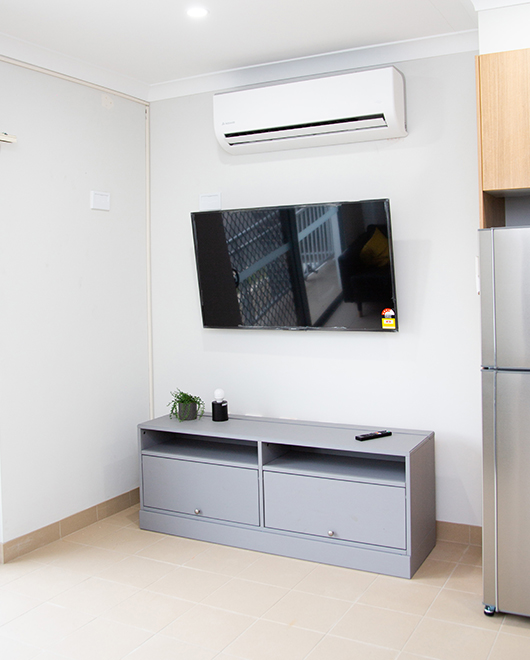

Perfect for cooling individual rooms or smaller spaces. We supply and install all the major brands with clean cable runs and a tidy finish.

Whole-home comfort with discreet ceiling vents. We design and install ducted systems sized properly for your home, not just whatever fits.

Cool multiple rooms off the one outdoor unit. Less clutter outside, independent control inside, and one clean install.

Split system air conditioning specialists in Sydney.
Splits are the most common form of air conditioning in Sydney, but that doesn’t mean every install is the same. The unit you pick, where it goes, and who fits it make a bigger difference than most people realise. Here’s the stuff worth knowing before you commit.
Splits are sized by their cooling output in kW, ranging from around 2.5kW for a small bedroom up to 9kW for a big open-plan living area. Pick a 2.5kW for a 40 square metre lounge and it’ll never keep up. Stick a 7kW in a small bedroom and it’ll freeze you out in five minutes, then cycle on and off all night.
As a rough rule, allow about 0.15kW per square metre for an average Sydney room with normal ceiling height, then bump it up if the room faces west, has poor insulation, or floor-to-ceiling glass. Anyone who quotes a unit without asking about the room is guessing.
The head should be high on the wall, away from windows and direct sun, and positioned so the airflow reaches the part of the room you actually use. Mounting it above the bed because that’s where the bracket fits easiest is a recipe for cold drafts on your face all night. A good installer will walk through the room with you and pick the spot before they even open a box.
Outdoor units pull air across the coil to dump heat, so they need clearance on all sides and somewhere shaded if possible. Tucking one into a tight courtyard or boxing it in behind a fence is a common cause of poor performance, especially in 35-degree-plus weather when the unit is working hardest. They also vibrate slightly and put out noise, so position matters for the neighbours too. A unit two metres from the next-door bedroom window is going to cause problems eventually.
Every decent split sold in Australia is now an inverter, which means the compressor adjusts its speed instead of just turning fully on or fully off. The result is faster cooling, quieter operation, and roughly 30-40% less power use compared to the old fixed-speed units that were standard ten years ago. If you’re being offered a non-inverter unit at a bargain price, walk away. The savings on power alone will pay back the difference in a couple of years.
If you’re planning to put splits in three or four rooms, it’s worth pricing a multi-split alongside individual units. One outdoor compressor running two to five indoor heads means less clutter on the side of the house, fewer holes through the wall, and usually a slightly cheaper power bill. The catch is that if the outdoor unit fails, all the indoor heads go down with it, so it’s a balance worth weighing up.
A split done properly will last 12-15 years with basic servicing. A dodgy install can have you replacing it in six. The difference usually comes down to small things: how well the pipework is brazed, whether the system gets vacuum-pumped before being charged, whether the drain is run at the right fall, whether the brackets are level. None of this shows up on day one. It shows up three summers later when the unit starts leaking water or losing gas. Pick the installer carefully, not just the cheapest quote.
Installations
Happy Customers
Maintenance Calls
Aircons Cleaned














For a single split, expect somewhere between $1,500 and $3,500 fully installed for most homes. The unit itself is usually $1,000-$2,500 depending on the brand and capacity, and standard installation runs another $500-$1,000 on top. Tricky installs (long pipe runs, second-storey, brick walls, awkward outdoor unit placement) push the install cost up. We’ll quote it properly after seeing the spot, no surprises after the fact.
As a rough guide, a 2.5kW unit handles a small bedroom up to about 20m², a 3.5kW does a standard bedroom or small living area, a 5kW covers most lounges, and 7-9kW is for big open-plan spaces. That’s the starting point, but ceiling height, insulation, window size, and which way the room faces all push the number up or down. Best to have someone measure the room before you order anything.
A single split is usually a half-day job, three to four hours from start to finish. We mount the indoor head, run and insulate the pipework through the wall, position the outdoor unit, vacuum the system, charge it with refrigerant, and pressure-test the lot before we leave. Multi-splits take longer since there are more heads to fit, usually a full day or two depending on the number of rooms.
Pretty much, yes. The main limits are pipework distance (most units handle up to 15-20 metres of pipe between indoor and outdoor) and somewhere reasonable for the outdoor unit to live. Apartments can be trickier because of strata rules and limited outdoor space, but it’s usually doable with the right setup. Old double-brick walls take a bit more work to drill through but aren’t a dealbreaker.
Yes, every modern split sold in Australia is reverse cycle, meaning it heats as well as cools. Reverse cycle is actually one of the cheapest ways to heat a room, much cheaper per hour than electric panel heaters or gas. For a Sydney winter where you only need heating for a few hours in the morning and evening, a split is a far better option than running a portable heater that doubles your power bill.
Advice and best practice from our own team

Get the size of your ducted air conditioning right and you barely think about it: every ro
0 Comments
If you are about to spend $10,000 or more on ducted air conditioning, it is fair to ask wh
0 Comments