 by Helal
Can One AC Unit Cool a Two-Story House? Factors to Consider and Solutions
Yes, with the right system. A single zoned ducted system handles a two-storey Sydney home comfortably when it’s properly sized, designed with separate upstairs and downstairs zones, and installed competently. A single split system, no, that’s not what splits are for. The middle option, a multi-split with one upstairs head and one or two downstairs, is genuinely workable for some homes but has trade-offs.
The detail behind that, including why upstairs is always the harder problem and what a good install actually looks like, is below.
Why two-storey homes are harder to cool
Heat rises. That’s the entire problem in one sentence. On a 38°C Sydney afternoon, the upper floor of a two-storey home can run 4 to 8°C warmer than downstairs even with the aircon running, because the system is fighting against physics.
A few specific factors make it worse.
Stack effect. Hot air pools at the top of the house. The further up you go, the harder the system has to work to keep that space at the same temperature as downstairs.
Roof loading. The upstairs ceiling sits directly under the roof cavity, which on a 38°C day runs 50 to 65°C up there. That heat soaks down through the ceiling all afternoon and into the evening. Downstairs has the upper floor as a buffer. Upstairs has nothing but ceiling insulation.
Sun exposure. Bedrooms upstairs typically have more direct sun through windows than downstairs living areas, particularly west-facing rooms in the late afternoon.
Bedroom use patterns. Upstairs is where everyone sleeps, which is the time of day cooling matters most. A system that handles downstairs fine but can’t keep bedrooms comfortable overnight is a system that fails the test.
This is why “can one system handle two storeys” really means “can one system properly handle the upstairs”. If it can do that, the downstairs takes care of itself.
Ducted with zoning is the answer for most two-storey homes
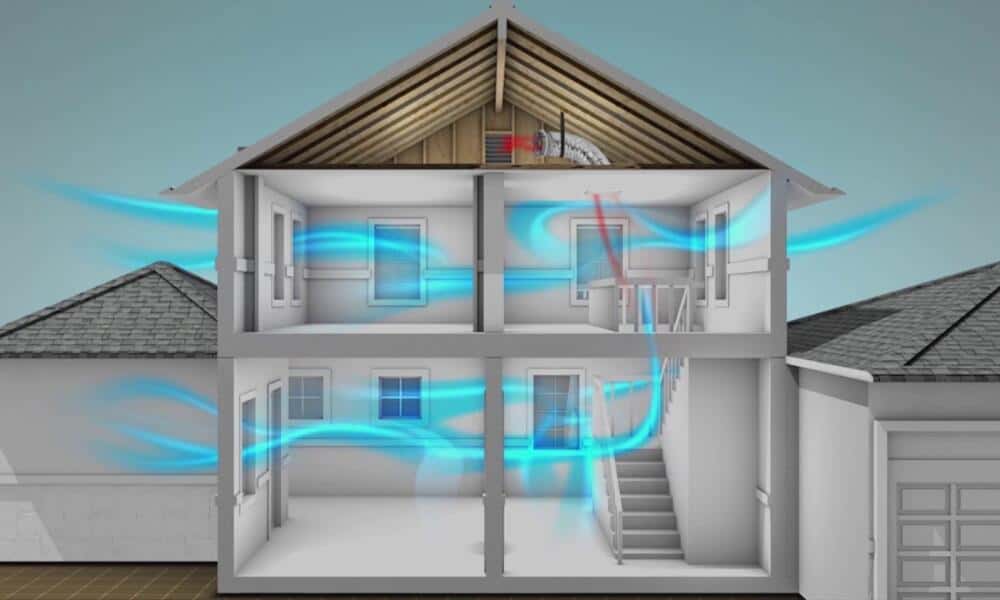
A properly designed ducted system with separate upstairs and downstairs zones is the cleanest solution and the one we install most often in two-storey Sydney homes.
What makes it work is the zoning. The system isn’t trying to cool both floors simultaneously to the same temperature. It runs the upstairs harder than the downstairs during the afternoon and evening, then shifts effort downstairs during the day when bedrooms are empty. Each zone has its own thermostat or sensor, and the system modulates output accordingly.
A few specifics that matter for two-storey installs:
Separate zones by floor at minimum. Upstairs and downstairs should never share zone control. Many sub-par installs we get called out to fix have one master bedroom zone and one “everywhere else” zone, which means the upstairs and downstairs are fighting each other for capacity.
Adequate capacity for the upstairs zone specifically. Sizing has to account for the fact that the upper floor is the harder cooling problem. Sizing the system off total floor area without weighting upstairs more heavily is a common install mistake.
Return air on both floors ideally. Return air on the lower floor only means the system is constantly drawing air from downstairs, conditioning it, and pushing it upstairs, where it then has nowhere to return from. Two-return setups (one on each floor) work much better for temperature consistency.
Proper duct insulation. Duct runs between floors carry conditioned air past unconditioned roof space and wall cavities. R1.5 minimum, R2.0 better, otherwise you’re losing capacity into the building structure.
A typical two-storey Sydney family home (four to five bedrooms) needs 14kW to 18kW of ducted capacity, properly zoned. Install cost runs $11,000 to $16,000 for a competent setup, more for larger homes or complex roof access.
Multi-split is a workable middle ground
If ducted isn’t an option (no roof space, heritage constraints, budget), a multi-split system with one outdoor unit and four to six indoor heads can handle a two-storey home reasonably well.
The pattern that works: one larger head in the upstairs hallway or main living area on each level, plus individual heads in bedrooms used overnight. Each indoor unit runs independently and can be turned off in unused rooms.
The trade-offs versus ducted: visible wall heads in every conditioned room rather than slim ceiling vents, harder to balance temperatures across rooms (each head is its own system rather than a coordinated whole), and outdoor unit placement gets harder when you’ve got refrigerant pipes running to four or five indoor units.
Multi-split installs in two-storey Sydney homes typically run $8,000 to $13,000 depending on number of heads and pipe run complexity. Cheaper than ducted up front, more visible afterwards.
A single split won’t cool a two-storey house
Worth being direct because it comes up at quote stage occasionally. A single 7.1kW split in the downstairs living area will cool the room it’s in. It will not cool the rest of the downstairs effectively, and it will not cool any room upstairs at all. Heat doesn’t transfer through walls and floors enough for that to work.
If your budget is genuinely a single split, you’re looking at cooling one space (the main living area) and accepting that the rest of the home runs at ambient. That’s a perfectly reasonable choice for some households. It’s not “cooling the whole home”, and any installer who suggests otherwise is overselling.
Western Sydney makes this harder
For homes in Liverpool, Penrith, Campbelltown, and the growth-corridor estates further west, the cooling load on a two-storey home runs noticeably higher than the same home would have closer to the coast.
Western Sydney summer days regularly run 5 to 8°C hotter than the eastern suburbs. The heat island effect in newer estates with large dark roofs, minimal mature trees and heavy paved surfaces (Oran Park, Leppington, Box Hill, Marsden Park) compounds this. A two-storey home in these areas with a system sized off generic Sydney averages will be undersized.
We typically size two-storey homes in these suburbs at the upper end of the kW-per-square-metre range, with particular attention to the upstairs zone capacity. Cutting corners on sizing in Western Sydney is the single most common reason we get called out to “fix” systems that work fine, just not in a 40°C afternoon.
What actually matters at quote stage
Some practical things to check or push for when getting quotes for a two-storey install.
A site visit, not a phone quote. Two-storey homes have too many variables (roof access, return air location, zone layout, electrical capacity) for accurate quoting without a walkthrough. If an installer is willing to quote a two-storey home from a phone call, the quote is a guess.
Proper sizing with the upstairs weighted appropriately. Ask the installer how they’re calculating capacity. “We did a load calculation accounting for upstairs solar gain and roof loading” is the right answer. “It’s about 15kW based on floor area” is not.
At least two zones, more if it’s a larger home. Single-zone ducted in a two-storey home is almost guaranteed to disappoint. Push for proper zoning at minimum.
Insulation conversation alongside the aircon. Two-storey homes with poor ceiling insulation are punishing to cool, and the right install often pairs with topping up ceiling insulation to R5.0 in the same project. Adding R5.0 batts to an under-insulated ceiling typically costs $2,500 to $5,000 and pays back in running cost savings within a few years.
ARC-licensed technicians on the install. Required by federal law for any refrigerant work. The licence number should appear on the quote.
Frequently asked questions
My upstairs is always warmer than downstairs even with the aircon running. Is that fixable? Almost always yes. Common causes are a single-zone system trying to cool both floors as one space, undersized capacity for the upstairs zone, return air only on the lower floor, or insufficient ceiling insulation. A site visit will identify which.
Can I add a second AC unit just for upstairs? Yes. Adding a dedicated split system to handle the upstairs is a common solution for homes where the existing downstairs system can’t reach the upper floor. Works well, especially if the existing system is otherwise functioning fine.
How long does ducted installation take in a two-storey home? 1 to 3 days depending on complexity. Roof access, electrical work, and ductwork routing between floors all add time compared to a single-storey install.
Do I need separate thermostats for each floor? At minimum, yes. Separate zones with separate temperature sensors is the entire point of a properly zoned ducted system. Some controllers (MyAir 5, AirTouch 5) allow individual room temperature sensors as well, which gives even finer control.
Will adding insulation help my existing system cool better? Significantly, yes. R5.0 ceiling insulation in an under-insulated home typically reduces upstairs cooling load by 20 to 30%. It’s often the cheapest single improvement available to a struggling system.